
As America marks 250 years of independence, it’s worth noting the presence and impact of Freemasonry during the nation’s founding. Some of the men who signed the Declaration of Independence, led the Continental Army, and drafted the Constitution were Masons. George Washington, Benjamin Franklin, and Paul Revere are among the most well known, but the list extends broadly across the founding generation. General Rufus Putnam, who was elected Ohio’s first Grand Master, served under General Washington during the Revolutionary War. Freemasonry provided these men with a shared set of values, such as brotherhood, equality, and the pursuit of truth. These ideals not only shaped their conduct in the lodge but their vision for a new nation. Some of the symbols central to our fraternity are still visible in American life today, in places most people encounter without realizing their origin.
The Eye of Providence

On the back of a dollar bill, on the left side, is the Eye of Providence, an eye set above an unfinished pyramid. It is also one of Freemasonry’s most recognized symbols, popularized by Thomas Smith Webb in his book The Freemason’s Monitor in 1797. In the lodge, it represents devotion to Brotherly Love, Relief, and Truth, and the watchful presence of the Grand Architect of the Universe. It appears on the Great Seal of the United States, where it represents divine guidance over the new nation. Positioned above the Eye are the Latin words Annuit Cœptis, meaning “He approves our undertakings”, which serves as a reference to Providence favoring the nation’s actions.
The Unfinished Pyramid
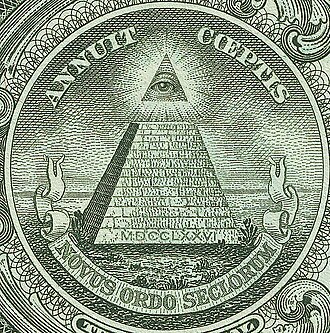
Also on the back of the dollar bill, beneath the Eye of Providence, is a pyramid of 13 steps representing the original colonies. It has no capstone. In Masonic tradition, an unfinished structure reflects the ongoing work of self-improvement, the idea that the labor of building a better man, and a better world, is never complete.
George Washington’s Masonic Apron
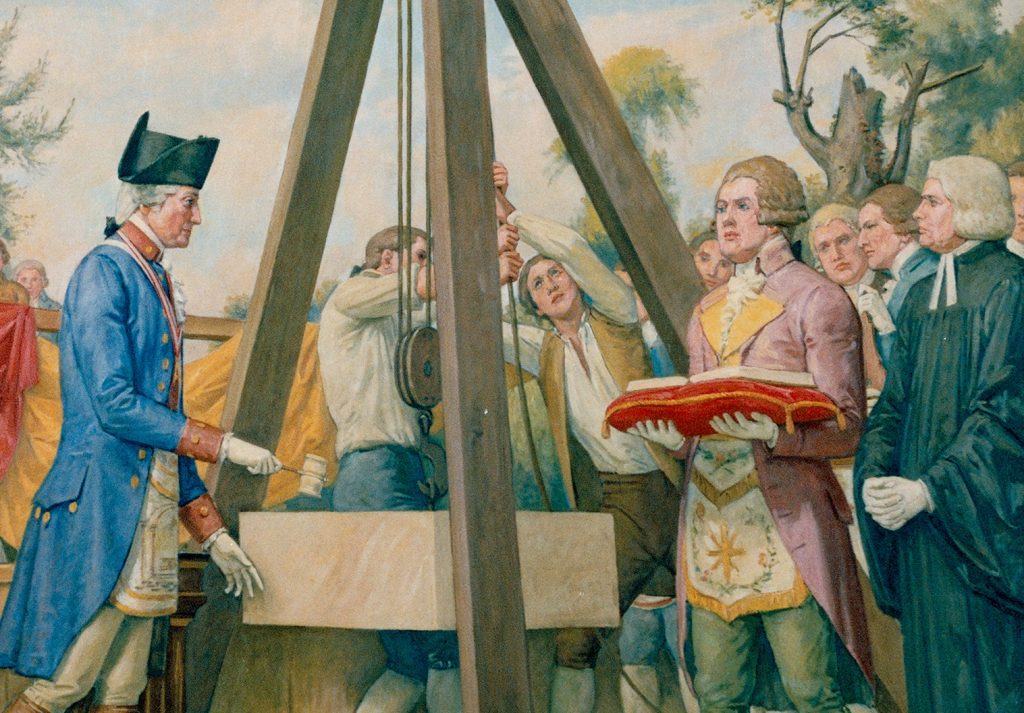
The Masonic apron traces its origins to the leather aprons worn by working stonemasons. In Freemasonry, it became a symbol of the labor Masons undertake in building their spiritual temples. George Washington wore a Masonic apron in 1793 when he laid the cornerstone of the United States Capitol.
The Square and Compasses

The square and compass is the most widely recognized symbol of Freemasonry. It is derived from the working tools of medieval stonemasons and represents the way Masonic teachings work to build better men. While it appears primarily in lodge rooms rather than in everyday public life, it was carried by many of the men involved in founding The United States, and remains a common marker on rings, buildings, and gravestones.
The Level

Among Freemasonry’s working tools, the level teaches that all men meet on equal footing. It is a principle central to Masonic lodge practice and one that also found expression in the founding documents of the United States. The Declaration of Independence and the Constitution both grappled with questions of equality that Masons had long considered a foundational value of the fraternity. While not all Founders were Masons, the fraternity’s principles of freedom, equality, and openness to religion aligned with Enlightenment ideals that shaped the nation’s founding documents.
Interested in the Ark and Anchor? Read more here. To learn more about Masonic Symbols, click here for an article about the Masonic Altar.